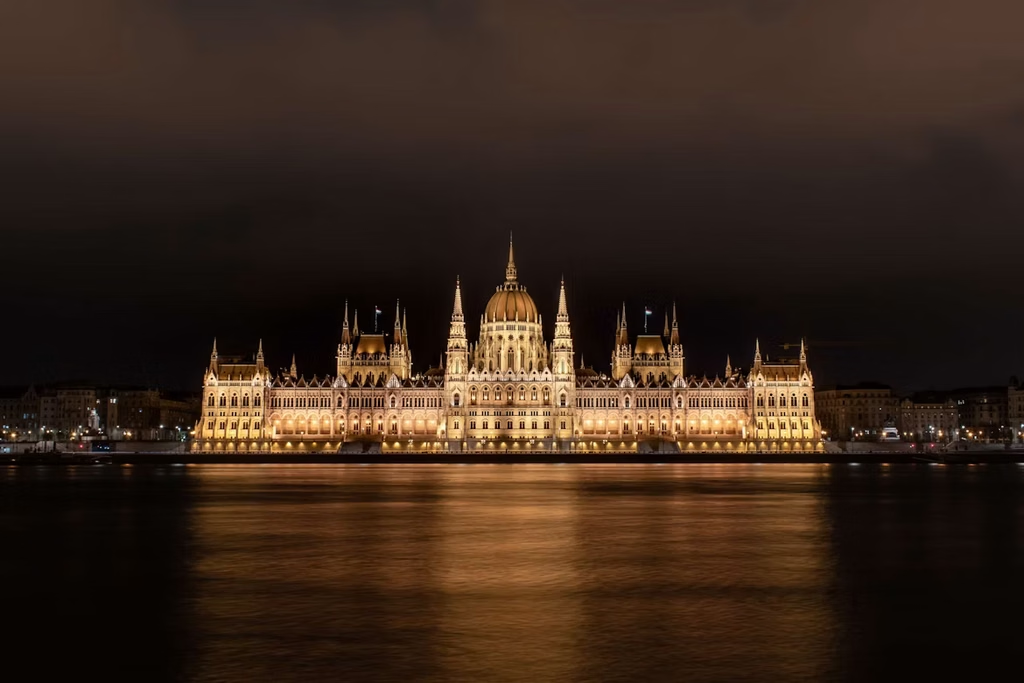
At the heart of Central Europe lies a country whose history has been shaped by migration, kingdoms, empires, revolutions, war, and cultural transformation. Hungary is a country where the past is not simply preserved in museums—it can be seen in its architecture, cities, traditions, and especially in its capital, Budapest.
To understand Budapest, one must first understand Hungary. And to understand modern Hungary, Budapest provides one of the clearest windows into its past.
The Beginning: The Magyars and the Carpathian Basin
The story of Hungary begins with the Magyars, who arrived in the Carpathian Basin around 895 CE. Over time, these communities developed into a centralized political society and established the foundations of the Hungarian state.
The transformation became particularly important under Stephen I, who became Hungary’s first king around the beginning of the eleventh century. By adopting Christianity and establishing a centralized Christian kingdom, Stephen connected Hungary more closely with the political and religious world of medieval Europe.
Centuries later, the legacy of this medieval kingdom would become deeply embedded in the landscape of Budapest.
From Medieval Kingdom to Budapest
During the medieval period, Buda emerged as an important royal center. Located on the western side of the Danube, its hills provided a naturally defensible location for a royal settlement and fortress.
Meanwhile, Pest, on the eastern side of the river, developed as an important commercial and urban center.
For centuries, Buda and Pest had distinct identities. Their eventual transformation into one city reflected Hungary’s broader political and economic development.
In 1873, Buda, Pest, and Óbuda were formally united to create Budapest.
The creation of Budapest marked more than an administrative change. It symbolized the emergence of a modern Hungarian capital.
Hungary Between East and West
Hungary’s geographical position has repeatedly placed it between major political powers.
The Battle of Mohács in 1526 marked a major turning point. The defeat of the Hungarian army contributed to the division of the Kingdom of Hungary and the expansion of Ottoman influence.
For much of the sixteenth and seventeenth centuries, Hungarian territories existed within a complex political landscape involving the Ottoman Empire, the Habsburg monarchy, and Transylvania.
Budapest itself carries traces of this history. Elements of Ottoman influence remain visible particularly through the city’s historic thermal-bath culture and surviving architectural heritage.
The Rise of Modern Budapest
The nineteenth century brought dramatic changes to Hungary.
The Revolution of 1848–49 expressed demands for political and national reform. Although the revolution was eventually defeated, it became an important part of Hungarian national memory.
Then came the Austro-Hungarian Compromise of 1867.
The following decades were a period of rapid modernization. Budapest expanded, transportation networks developed, public buildings transformed the skyline, and the city became a major center of education, science, culture, politics, and commerce.
The Hungarian Parliament Building, standing beside the Danube, reflects the confidence and ambitions of this era.
Budapest was becoming not merely a capital, but a major European metropolis.
The Danube and the Identity of Budapest
Few geographical features are as closely associated with a city as the Danube is with Budapest.
The river separates Buda and Pest while simultaneously connecting them.
Bridges—including the famous Széchenyi Chain Bridge—helped transform the two sides into an integrated urban center.
Today, the Danube provides a physical reminder of Budapest’s history: the medieval hills of Buda, the grand architecture of Pest, and the bridges connecting them all form one continuous urban landscape.
War, Loss, and Resilience
Hungary experienced enormous political and territorial changes during the twentieth century.
After World War I, the collapse of Austria-Hungary fundamentally changed the country’s position. The Treaty of Trianon in 1920 dramatically reduced Hungary’s territory and population, leaving a lasting impact on Hungarian national memory.
Then came World War II.
Budapest suffered extensive destruction during the war, while Hungary’s Jewish population faced persecution and mass murder during the Holocaust. The Siege of Budapest in 1944–45 caused particularly severe damage to the city.
Many of Budapest’s bridges were destroyed, and large sections of the city required reconstruction.
Yet the city survived.
Budapest and the Revolution of 1956
In 1956, Budapest once again became the center of a major historical event.
A nationwide uprising began with demonstrations in the capital and developed into an attempt to challenge Hungary’s communist government and Soviet domination.
The Soviet military intervention eventually suppressed the revolution.
Today, the events of 1956 remain an important part of Hungary’s historical consciousness and are commemorated throughout the country.
From Communist Hungary to Modern Europe
Hungary’s political system changed dramatically in 1989, when communist rule came to an end and the country began its transition toward a multiparty democratic system.
Budapest subsequently developed into an increasingly international city.
Universities attracted students from around the world. Businesses expanded. Tourism grew. Historic buildings were restored alongside the development of modern cultural and commercial spaces.
Hungary later joined NATO in 1999 and the European Union in 2004, further integrating the country into European institutions.
Budapest Today
Modern Budapest is a fascinating combination of historical layers.
A single journey through the city can reveal medieval fortifications, Ottoman-era influences, nineteenth-century architecture, twentieth-century memorials, and contemporary European culture.
The city is home to universities, museums, libraries, research institutions, theatres, cafés, markets, and cultural communities from across the world.
Yet Budapest’s modern identity does not erase its history. Instead, the old and new exist together.
Hungary Beyond Budapest
Although Budapest is the country’s best-known city, Hungary extends far beyond its capital.
The country contains historic towns, castles, thermal regions, rural landscapes, vineyards, lakes, and cultural traditions that reflect different periods of Hungarian history.
Places such as Lake Balaton, Pécs, Szeged, and Debrecen demonstrate that Hungarian identity is not limited to Budapest.
Still, Budapest remains the country’s cultural and political center—and perhaps the place where Hungary’s many historical layers become most visible.
Conclusion: A Country Written Into a City
Hungary’s history is a story of transformation.
The Magyars established a new political identity in Central Europe. Christianity connected the kingdom with medieval Europe. Ottoman and Habsburg rule reshaped its political landscape. Revolution and modernization transformed society. Two world wars brought destruction and territorial change. Communist rule created another historical chapter, followed by the democratic transition of 1989.
And throughout these transformations, Budapest evolved alongside the country.
Its castles reflect medieval Hungary. Its baths recall Ottoman influence. Its grand boulevards and Parliament reflect nineteenth-century modernization. Its monuments remember twentieth-century conflict. Its universities and international communities represent the Hungary of today.
Budapest is therefore more than a capital city—it is a living map of Hungarian history.
To walk through Budapest is, in many ways, to walk through the history of Hungary itself.
Leave a Reply