There are places in history that feel less like a chapter in a textbook and more like a dream.
Ancient China is one of them.
Imagine mist drifting between distant mountains, red lanterns glowing beneath palace roofs, silk robes moving through quiet courtyards, warriors standing beneath enormous gates, and an ancient dragon rising in the imagination above the clouds.
This is the China that lives somewhere between history and legend—a world of emperors, scholars, warriors, dynasties, dragons, and walls stretching across the mountains.
But beneath the cinematic beauty lies something even more fascinating: a civilization that spent thousands of years asking profound questions about power, nature, knowledge, morality, and humanity.
The Dragon: More Than a Creature
Few symbols are as deeply connected with Chinese civilization as the dragon.
Unlike many Western traditions where dragons are often portrayed as destructive monsters, the Chinese dragon traditionally carried very different meanings. It was associated with water, rain, prosperity, power, and cosmic forces.
The dragon became closely connected with imperial authority. In the imagination of imperial China, it was not simply a mythical animal—it represented a connection between earthly rulers and the larger order of the universe.
This is perhaps why dragons appear so naturally in Chinese historical dramas.
A C-drama may show a dragon carved into a throne, embroidered into imperial clothing, or appearing through clouds during a moment of destiny.
The imagery is fictionalized for storytelling, but the symbolism has deep historical roots.
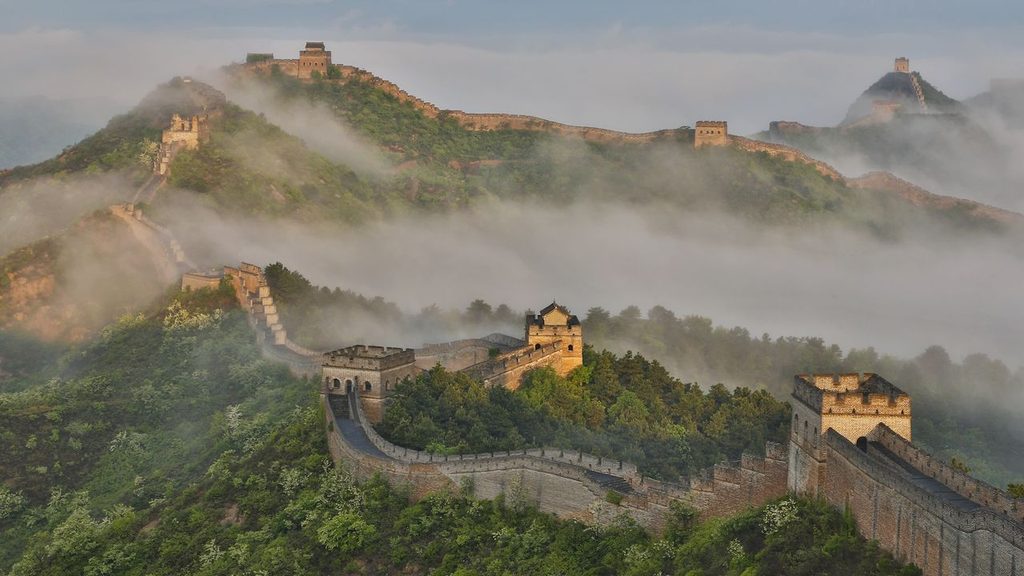
The Great Wall: A Monument of Fear and Survival
Then comes the Great Wall.
Winding across mountains like a stone serpent, it is one of the most recognizable monuments in human history.
But the Great Wall was not built all at once.
Different states and dynasties constructed, rebuilt, connected, and expanded defensive walls over centuries. The fortifications served military and strategic purposes, including controlling movement and protecting important territories.
The sections most commonly associated with the Great Wall today were largely developed during the Ming dynasty, centuries after some of the earliest walls had already existed.
Standing on the wall today, it is easy to imagine ancient soldiers watching the horizon.
Beyond the mountains was uncertainty.
Inside the walls was a civilization attempting to protect its borders, trade routes, cities, and people.
The Great Wall therefore represents something deeper than architecture.
It represents the ancient human desire to create a boundary between the known and the unknown.
The World of Emperors and Palaces
Ancient China was shaped by powerful dynasties.
Qin.
Han.
Tang.
Song.
Yuan.
Ming.
Each dynasty left behind its own political structures, artistic traditions, technologies, conflicts, and cultural memories.
The emperor stood at the center of imperial political life, surrounded by elaborate courts, officials, scholars, soldiers, artists, and countless rituals.
This is where historical C-dramas often create their most captivating atmosphere.
Palaces become worlds of their own.
A quiet corridor can hide political negotiations. A formal ceremony can determine someone’s fate. A single letter can travel through a kingdom.
Although dramas often dramatize these situations, they draw inspiration from a real imperial bureaucracy in which examinations, officials, family connections, military power, and political alliances could profoundly affect people’s lives.
When Mountains Become Characters
Ancient Chinese culture developed a particularly powerful relationship with nature.
Mountains were not merely geographical objects.
Rivers, forests, clouds, and mountains became subjects of poetry, painting, philosophy, and spiritual reflection.
This is one reason ancient Chinese landscapes feel almost otherworldly.
A scholar standing beside a mountain could contemplate the same landscape that a painter would later transform into art.
Mist-covered mountains became symbols of mystery.
Flowing water suggested change.
The empty spaces in traditional paintings could represent what cannot easily be expressed.
Nature was not simply something to conquer.
It was something to understand.
The Philosophy Behind the Silence
Ancient China also produced philosophical traditions that influenced society for centuries.
Confucian thought emphasized ideas such as moral cultivation, social responsibility, education, and relationships.
Daoist traditions explored harmony, naturalness, balance, and the relationship between human beings and the natural world.
These ideas help explain something often noticed in Chinese historical storytelling: the importance of duty versus desire, individual choice versus social responsibility, and human ambition versus harmony.
A warrior may want freedom but carry a duty.
An emperor may possess enormous power but remain bound by expectations.
A scholar may seek knowledge rather than wealth.
And a character standing beneath a mountain may be searching not for an enemy, but for an answer.
The Warrior Beyond the Legend
The ancient Chinese world was also a world of warfare.
Weapons, military strategy, cavalry, fortifications, political alliances, and territorial conflicts shaped the history of successive dynasties.
And from this world emerged one of the most influential military texts ever written:
The Art of War, traditionally attributed to Sun Tzu.
Its influence extends far beyond battlefields. Ideas concerning strategy, preparation, information, and understanding one’s circumstances have been interpreted in many different fields throughout history.
This is another reason the ancient Chinese world feels so intellectually rich.
It was not only about swords.
It was about strategy.
Not only about emperors.
But about systems.
Not only about legends.
But about ideas.
The China Between History and Myth
Perhaps the most beautiful part of ancient China is the space where history ends and imagination begins.
There were real emperors.
Real battles.
Real dynasties.
Real scholars.
Real walls stretching across mountains.
And alongside them existed stories of dragons, immortals, celestial beings, legendary heroes, magical weapons, and supernatural realms.
Modern C-dramas often bring these worlds together.
A historical palace may become the stage for a fictional love story.
A real dynasty may become the setting for an imagined kingdom.
A mountain may become the home of an immortal.
And a dragon may rise above the clouds.
The result is not always history.
But it can be a doorway into history.
Why Ancient China Still Fascinates Us
Perhaps we are not fascinated by ancient China simply because it was powerful.
We are fascinated because it was complex.
It built walls, but also wrote poetry.
It developed political institutions, but also created legends.
It studied the stars, cultivated philosophy, developed technologies, painted landscapes, and imagined worlds populated by creatures that still live in our culture today.
And somewhere between the Great Wall and the mountains, between imperial palaces and quiet temples, between historical records and dragon legends, lies a civilization that continues to ask us an ancient question:
How much of the world remains unknown to us?
Maybe that is why the image of ancient China stays with us.
Not merely because of its dragons.
Not merely because of its emperors.
Not merely because of the Great Wall.
But because behind every mountain, every forgotten dynasty, every ancient manuscript, and every legend, there seems to be another story waiting to be discovered.
And perhaps the greatest mystery of ancient China is not what we already know—
but how much remains beyond the horizon.

Leave a Reply