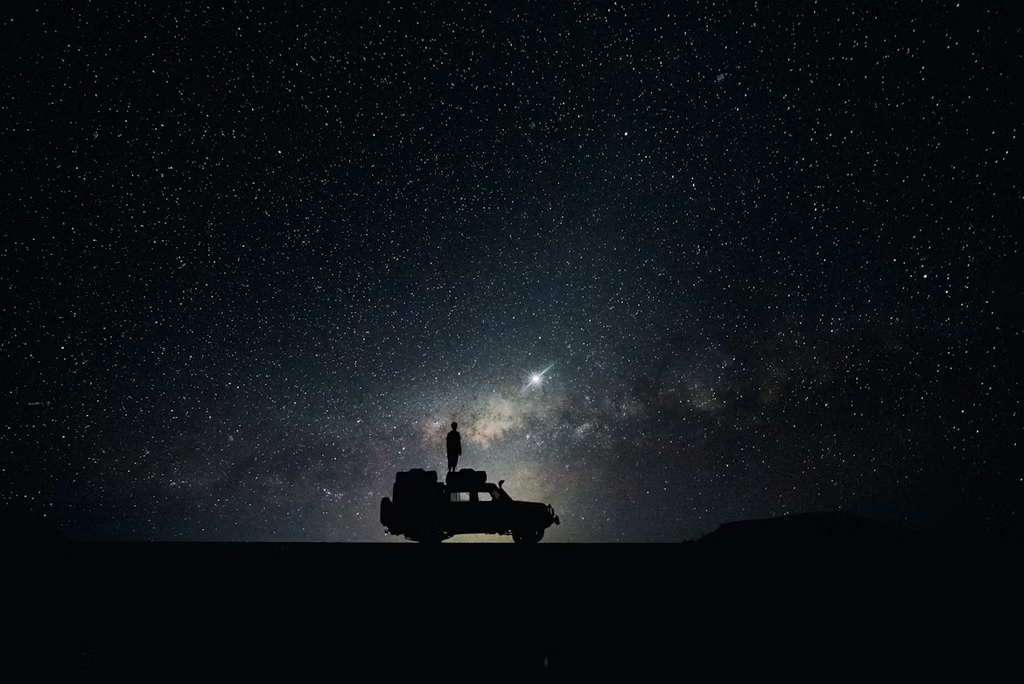
There is something profoundly humbling about standing beneath a clear night sky.
A few stars become visible to the naked eye, yet behind that familiar darkness lies an unimaginably vast universe—galaxies, distant worlds, nebulae, black holes, and phenomena that humanity is still trying to understand.
And perhaps that is why I love looking at the sky.
Not simply because it is beautiful.
But because it reminds me of how much remains unknown.
The Beauty of Not Knowing
We often think of knowledge as having answers.
But sometimes, knowledge begins with realizing that we do not have them.
Why does the universe exist?
Are there other worlds capable of supporting life?
What lies beyond what our instruments can observe?
How did the first stars emerge?
And how much of reality do we still fail to perceive?
The more we learn about the universe, the more questions seem to appear.
That is not a failure of knowledge.
It is one of the reasons learning is so beautiful.
When Curiosity Becomes a Form of Love
Perhaps curiosity is its own kind of love.
To love something is often to want to understand it—to look closer, ask questions, notice details, and remain interested even when there is no simple answer.
The night sky creates that feeling naturally.
You look at one star and begin wondering about another.
You learn about a galaxy and suddenly want to understand how galaxies form.
You discover planets beyond our Solar System and begin wondering whether we are truly alone.
One question leads to another.
And another.
Until learning itself becomes an endless journey.
The Sky Teaches Us Humility
Humanity has achieved extraordinary things.
We have developed telescopes capable of observing objects billions of light-years away. We have sent spacecraft beyond Earth. We have learned that the stars themselves are not simply points of light, but enormous physical systems governed by the laws of nature.
Yet every discovery also reveals another layer of uncertainty.
The universe does not become smaller as we understand it.
It becomes larger.
That is perhaps one of the most important lessons the sky can teach us:
Knowledge does not always reduce mystery. Sometimes, it gives mystery a deeper shape.
And Then There Is Love
There is something poetic about the fact that humans have always connected the sky with love.
People have looked at the same moon while separated by distance. They have written poems about stars, imagined stories among constellations, and searched the heavens for meaning.
But perhaps there is another kind of love hidden there—the love of wondering.
Not necessarily love for a person.
Not even love for a particular place.
But love for existence itself.
The desire to understand what is beyond us.
The excitement of discovering something we did not know yesterday.
The feeling of looking at the universe and thinking:
There must be more to learn.
We Are Made of Questions
Perhaps growing up is not about eventually finding every answer.
Perhaps it is about learning how to ask better questions.
A child looks at the Moon and asks, “What is it?”
A student asks, “How does it work?”
A scientist asks, “Why does it behave this way?”
And eventually, another question appears:
What else don’t we know?
That question can take us further than certainty ever could.
It can lead us toward science, philosophy, literature, psychology, astronomy—or simply toward a deeper understanding of ourselves.
A Starry Night Is an Invitation
So, the next time you look at a starry sky, perhaps don’t look at it only as something beautiful.
Look at it as an invitation.
An invitation to wonder.
To question.
To learn.
To accept that there are things we cannot yet explain.
And to remain curious enough to keep searching.
Because perhaps the real beauty of the night sky is not that it gives us all the answers.
It is that, for a moment, it makes us fall in love with the questions.
Beneath the stars, we are reminded of how small we are—but also of how extraordinary it is that we are capable of looking up, wondering, and trying to understand.
Leave a Reply