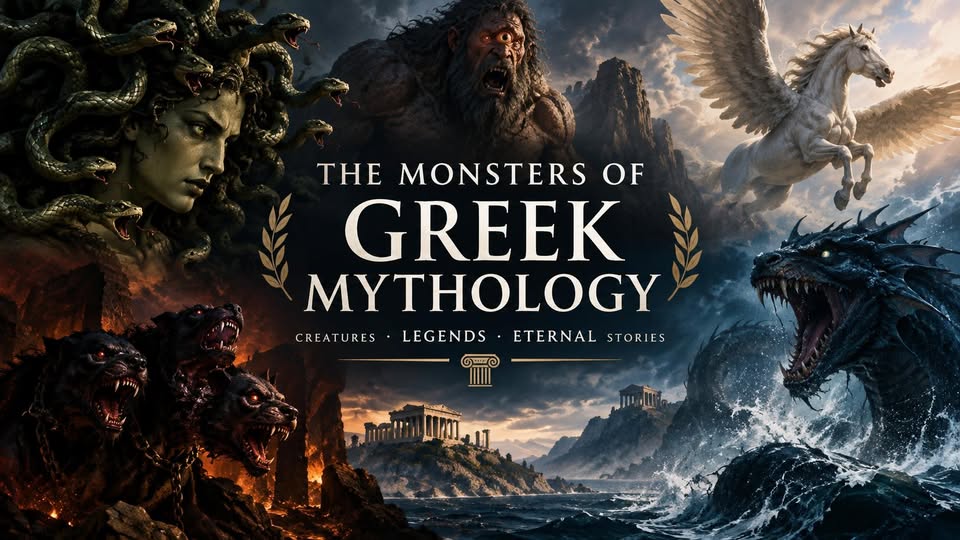
Greek mythology is filled with a vast array of creatures, ranging from hybrid beings and monstrous giants to legendary animals and underworld spirits. Some possessed extraordinary strength, some were associated with death and destruction, while others represented temptation, fear, chaos, or the unknown.
For thousands of years, these creatures have survived through stories, poetry, art, theatre, and literature. But why have these ancient monsters remained so fascinating?
Perhaps because they were never merely monsters.
Behind many of them lies something much more human: fear, desire, uncertainty, suffering, and the struggle to understand what cannot easily be explained.
A World Where the Unknown Took Shape
Ancient Greek society existed in a world where many natural phenomena were difficult to understand scientifically.
Storms, earthquakes, disease, death, dangerous animals, the vastness of the sea, and the darkness of the night could all inspire fear.
Mythology gave these fears a shape.
Instead of remaining invisible and abstract, the unknown could become a creature.
A terrifying sea monster could represent the dangers of the ocean. A creature guarding the entrance to the Underworld could represent humanity’s fear of death. A hybrid creature could represent the disturbing idea of something that does not belong completely to one category.
In this way, mythology transformed uncertainty into narrative.
The Minotaur: The Monster at the Center of the Labyrinth
The Minotaur is one of the most famous creatures in Greek mythology.
With the body of a human and the head of a bull, the creature was imprisoned within the Labyrinth constructed by Daedalus.
The story is usually remembered as a heroic adventure: Theseus enters the Labyrinth, confronts the Minotaur, and escapes.
But the symbolism can be taken further.
A labyrinth is not simply a physical structure. It is a place where direction disappears. You can move forward without knowing whether you are getting closer to an exit or moving deeper into confusion.
The Minotaur at its center can therefore be understood as a representation of the frightening unknown hidden within a complicated environment.
This interpretation does not mean that the ancient Greeks necessarily intended the myth as a psychological theory. Rather, it demonstrates why myths remain open to interpretation.
The Labyrinth can become a metaphor for the complexity of the human experience itself.
Sometimes, the greatest challenge is not simply defeating a monster.
It is finding your way through the maze.
Medusa: Fear, Power, and Transformation
Medusa is another creature whose image has changed dramatically across history.
She is traditionally described as a Gorgon whose gaze could turn people to stone.
Her story contains an unusual form of power: the ability to make someone incapable of moving simply through sight.
That image makes Medusa an enduring symbol of fear.
But later interpretations have also examined her through themes of victimhood, power, gender, punishment, and transformation.
This demonstrates something important about mythology:
A myth does not always have one permanent meaning.
The same character can be interpreted differently by different societies and generations.
As our understanding of power and human behavior changes, the symbols we inherited from ancient cultures can acquire new meanings.
The Hydra: Why Some Problems Grow When We Fight Them
The Hydra was a serpent-like creature associated with the region of Lerna. Its most famous characteristic was its multiple heads.
In the story, Hercules was required to defeat it as one of his Labors. The creature was difficult to overcome because cutting off one head could result in additional heads emerging.
The Hydra has therefore become a powerful metaphor for problems that multiply instead of disappearing.
A person may solve one visible problem only to discover that another has appeared underneath it.
The same pattern can occur in societies, organizations, and personal relationships.
A problem sometimes survives because its underlying causes remain untouched.
The Hydra offers a simple but powerful lesson:
Removing a symptom is not always the same as solving the problem.
The Sirens: The Voice of Temptation
The Sirens were mysterious beings whose beautiful singing attracted sailors toward danger.
Their story reflects one of the oldest conflicts in human behavior:
Knowing something is dangerous does not necessarily make it less attractive.
This conflict remains familiar today.
People can understand the consequences of procrastination and still procrastinate. They can recognize an unhealthy habit and still struggle to abandon it. They can know that excessive distraction reduces concentration while continuing to return to the same distractions.
The modern world may look completely different from ancient Greece, but the conflict between knowledge and desire remains.
The Sirens, therefore, can be read as a metaphor for temptation itself.
Cerberus: The Guardian of the Boundary
Cerberus, the multi-headed guardian of the Underworld, was said to prevent the dead from leaving and the living from entering.
Unlike creatures whose primary purpose was destruction, Cerberus had a specific function.
He guarded a boundary.
And boundaries have always fascinated human beings.
Life and death.
Known and unknown.
Human and divine.
Order and chaos.
The Underworld represented a place beyond ordinary human experience. Cerberus stood at its entrance, turning an abstract fear into a recognizable figure.
Perhaps this is one reason guardian monsters appear so frequently in mythology: they stand between humans and something they cannot fully control.
The Chimera: The Fear of the Impossible
The Chimera was another famous Greek creature, traditionally described as a combination of different animals.
Its hybrid nature is significant.
Humans naturally categorize the world: human and animal, land and sea, living and dead.
A creature that violates these categories can feel unsettling precisely because it does not fit comfortably into an existing mental framework.
The Chimera therefore represents another recurring feature of mythology: the fascination with things that should not exist according to ordinary experience.
Mythology creates creatures that break the rules of reality.
And perhaps humans have always been fascinated by the possibility of breaking those rules.
Why Are We Still Fascinated by Monsters?
Modern science has changed our understanding of the world enormously.
We can explain many phenomena that ancient societies could only describe through mythology.
Yet monsters have not disappeared.
They have simply changed form.
They appear in novels, films, video games, paintings, folklore, comics, and popular culture.
Why?
Because the emotional experiences behind them remain.
We still fear the unknown.
We still struggle with temptation.
We still encounter problems that seem to multiply.
We still wonder about death.
We still experience internal conflicts that are difficult to explain.
The creatures of mythology may be imaginary, but the emotions they represent are very real.
Perhaps the Monster Was Never the Point
Greek mythology does not simply give us stories about creatures.
It gives us stories about human beings confronting something larger than themselves.
A hero enters a labyrinth.
A warrior faces a creature that seems impossible to defeat.
A sailor hears a voice promising something beautiful.
A guardian stands before the unknown.
These stories repeatedly place humans at the boundary between what they understand and what they fear.
And perhaps that is why they survived.
The ancient Greeks created monsters, but those monsters became mirrors.
They reflected human fears back at humanity.
Thousands of years later, we may no longer believe that these creatures exist physically.
But when we read their stories, we still recognize something familiar.
The monsters changed.
The human mind did not.
Leave a Reply